
Monday, 23 February 2026
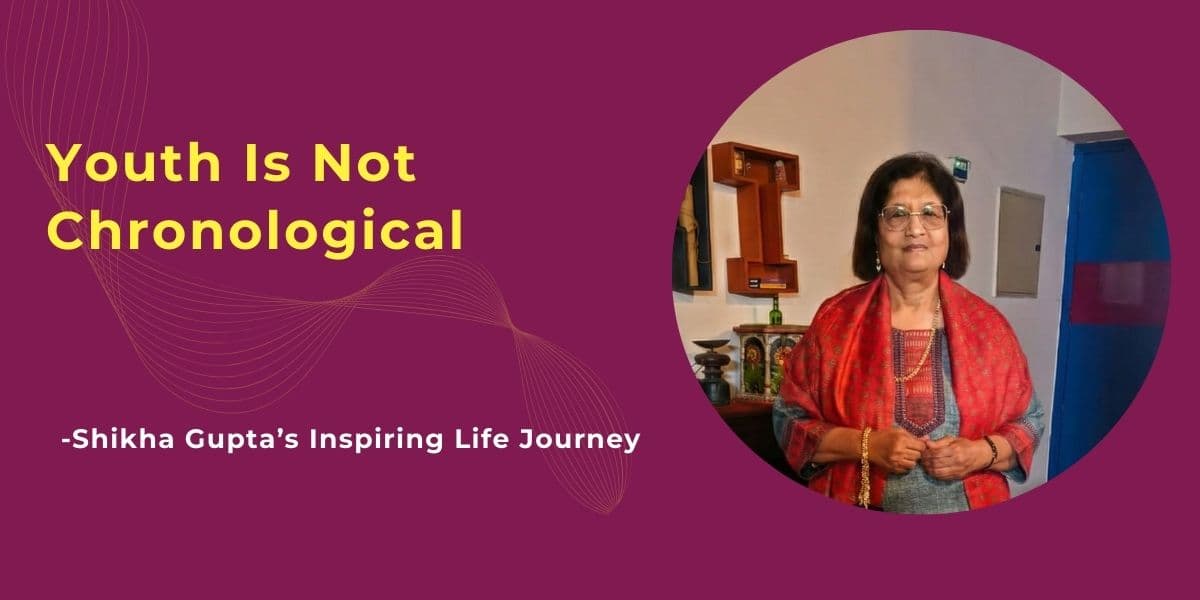
Youthfulness Is Not Chronological: Shikha Gupta’s Inspiring Life Journey
“Anyone who keeps learning stays young," Henry Ford once said. If that is true, then Shikha Gupta has quietly mastered the art of youthfulness. At 66, she trains MBA students in soft skills with the energy of someone half her age. Every morning begins with 30 minutes of German practice. She reads The Times of India and The Economist diligently and follows podcasts on geopolitics to stay mentally sharp.
You might be wondering, what on earth is her secret for such a vibrant, youthful life at 66? Well, before I let you in on that little secret, let's just retrace Shikha Gupta's journey, because every vibrant present is truly rooted in a meaningful past.
A Foundation Built on Values
Shikha was born in Ajmer in 1959, at her maternal grandparents’ home, as was customary. However, her upbringing unfolded across small towns in Uttar Pradesh in a disciplined household. Her father, a man of discipline, was a Judge. Her mother, a homemaker, was the quiet backbone of the household. Along with her sister, it was an ideal Indian family.
In 1964, when Shikha was just five, her father enrolled both daughters in a convent school, in Jhansi, run by Irish nuns. This place became the crucible where her character got forged. At St Francis Convent School, in addition to learning subjects, essential values were being taught. As a result, there, she absorbed a moral framework. The stories of Jesus Christ were presented as lessons in compassion and faith.
“They taught us to become good human beings,” she reflects.
At home, too, her parents taught her humility and compassion towards the less fortunate. Overall, in her childhood, she learned to be a caring human being.
Academic Brilliance and a Practical Detour
Academically, too, Shika was gifted. She consistently topped her classes. After moving to Delhi in her early teens, she completed her schooling and went on to study English Honours at Jesus and Mary College, Delhi University. She later pursued law, inspired by her father’s judicial career.
And yet, after she finished law, life took a pragmatic turn.
Factors such as marriage, relocation, and social realities influenced career decisions for women then. Continuing down the path of law would tie her to a single city, she realised. So, she shifted her focus to competitive examination eg Banking. It offered flexibility that law profession didn’t. So, she sat for banking exams. She qualified. And before she truly realised it, she was an officer at Punjab National Bank (PNB).
However, within a week, she just knew.
“This is not where my soul belongs.”
But leaving was not simple. Government jobs were coveted. Stability mattered. Banking offered transferability.
So, she stayed on.
And she did not stay half-heartedly.
Excellence Without Attachment
For 17 years, Shikha served in the bank. Her days were long, and everything had to be done manually, as it was the pre-computer era. The word was repetitive. Above all, the intellectual stimulation she craved was absent. Nevertheless, she never allowed dissatisfaction to breed mediocrity. That, perhaps, was the defining discipline of those years: excellence without emotional attachment.
She worked diligently every day. Every customer left satisfied with her service. Her confidential reports were consistently rated “A”. Managers appreciated her. Customers remembered her. She was a perfect employee throughout her career.
The Turning Point
In her final posting at the corporate office of PNB, an insightful senior officer in the HR division saw something in her. He observed her language skills, her intellectual bent, and her hunger to grow as a professional. He invited her to become part of a new HR cell studying modern European and American HR practices, examining how they could be adapted to an Indian public-sector bank.
It was her eureka moment!
For the first time in 17 years, she was reading, researching, writing policy papers, and engaging with ideas. She flourished! It confirmed what she had always sensed: she was born for language, training, and intellectual engagement. But still, she knew she could do more. So, when the Reserve Bank introduced a Voluntary Retirement Scheme requiring only 15 years of service, at 41, she stepped out.
Reinvention at 41
Many fear starting over at 41. Shikha felt relief and immense enthusiasm for charting a new course. Reflecting on that moment, Shikha Gupta reflects,
“I felt I was born after leaving the bank.”
Post-retirement, she built a life around her natural inclinations. She became a visiting faculty member, teaching management students. She conducted English proficiency and soft skills training. She coached students for corporate interviews. She worked as a senior editor with multinational firms. She authored commemorative documents, annual reports, and corporate brochures — every word carefully chosen. Her work became an extension of her mind. Shikha had found her niche!
The Deeper Lesson
Success is subjective. It varies from one person to another, based on one’s goal. In the case of Shikha Gupta, she did not measure success by designation or income. She measured it by intellectual fulfilment. At 66, she still signs up for workshops. She still reads voraciously. She still feels that quiet excitement before entering a classroom of 23-year-olds. So, in her scale, she couldn’t be more successful. But there is a deeper lesson for us in this success story that others could learn from.
Youthfulness, in the end, is not chronological. It is a product of a mind which refuses to age or dull.
And Shikha Gupta intends to remain young at heart and keep working meaningfully, for as long as she can!